

 By
By On February 28, 2026, the United States and Israel launched coordinated strikes on Iran. President Donald Trump announced the action in an eight-minute video on Truth Social, making bold claims about Iran’s nuclear weapons and long-range missile capabilities. TrendingUpdatesToday.com breaks down what Trump actually said — and what the evidence shows.

What Trump Claimed About Iran’s Nuclear Threat
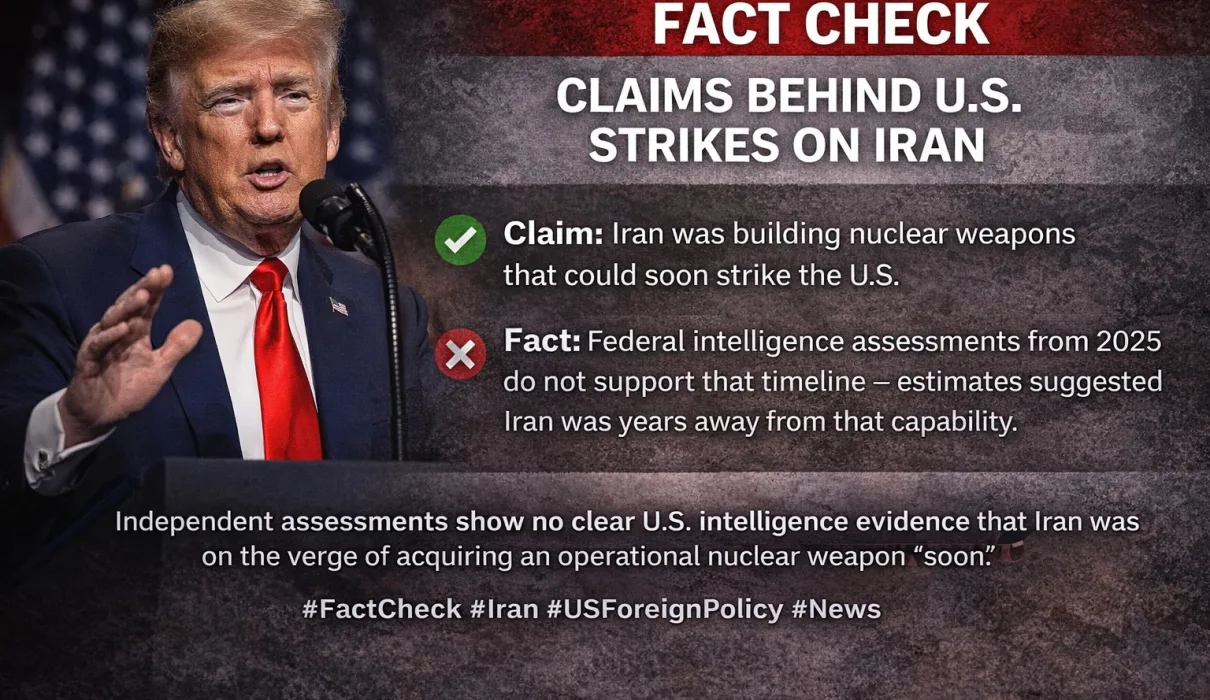
Trump stated that Iran was actively building nuclear weapons and developing long-range missiles that could “soon” reach the American homeland. He said Iran “rejected every opportunity to renounce their nuclear ambitions,” forcing the U.S. to act again after the June 2025 strikes on Iranian nuclear sites at Fordow, Natanz, and Isfahan.
He also repeated his claim that those earlier strikes “obliterated” Iran’s nuclear facilities — a word that carries significant weight and sets the stage for the 2026 operation.
So, how do these claims hold up against available evidence?

What U.S. Intelligence Actually Says About Iran’s Missile Capability
The central question is: can Iran missiles reach the United States?
The Defense Intelligence Agency (DIA) released a missile threat assessment in May 2025. That report concluded that Iran could potentially develop an intercontinental ballistic missile (ICBM) by 2035 — if it chooses to pursue one. That is nearly a decade away, not “soon.”
Daryl Kimball, executive director of the Arms Control Association, noted that the U.S. intelligence community has held a similar assessment since the mid-1990s — that Iran might develop an ICBM within a decade.
Richard Nephew, who worked on Iranian policy during the Biden administration, confirmed that Iran already has missiles capable of reaching parts of eastern Europe. But ICBMs are a much harder technical challenge. He said Iran’s ICBM capabilities remain many years away — consistent with the DIA’s assessment.
The distance from Tehran to Washington, D.C., is approximately 10,000 kilometers. Iran’s current top missile range is around 2,000 kilometers, according to Gary Samore, a Brandeis University professor and former nonproliferation expert in the Obama and Clinton administrations.
Even Secretary of State Marco Rubio acknowledged he couldn’t say how far away Iran was from developing missiles that could reach the U.S.

Trump’s “Obliterated” Claim vs. Official U.S. Government Language
Trump’s description of the June 2025 strikes deserves a closer look. He repeatedly used the word “obliterated” to describe the damage to Iran’s nuclear sites.
However, the White House’s own November 2025 National Security Strategy document used far more measured language — stating that the strikes “significantly degraded Iran’s nuclear program.”
There is a meaningful difference between “obliterated” and “significantly degraded.” The first implies total destruction. The second suggests serious damage but not elimination.
Nuclear policy experts who reviewed Trump envoy Steve Witkoff’s February 2026 claim — that Iran was “probably a week away” from bomb-making material — expressed public skepticism. The International Atomic Energy Agency (IAEA), which normally tracks Iran’s nuclear activity, has been unable to access the bombed sites since 2018, when Trump withdrew the U.S. from the Iran nuclear deal. Without independent verification, confirmed facts about Iran’s current nuclear status remain unavailable.

Trump’s Iran Strike Claims vs. What Experts and Intelligence Say
| Claim | Trump’s Statement | What Evidence Shows |
| Iran missiles reaching U.S. | “Could soon reach the American homeland” | DIA says ICBM possible by 2035 at earliest |
| Nuclear facilities destroyed | “Obliterated” Iran’s nuclear sites | White House doc says “significantly degraded” |
| Iran nuclear bomb timeline | “Week away” (Witkoff, Feb. 2026) | Experts say claim is not credible |
| Congressional approval | None sought | Democrats and some Republicans push war powers vote |

The War Powers Question
Trump did not seek congressional approval before ordering the February 2026 strikes. This mirrors his approach to the June 2025 nuclear strikes and the January ouster of Venezuela’s leader Nicolás Maduro.
In response, members of both parties in the House and Senate pushed to hold a war powers resolution vote. The U.S. Constitution gives Congress the authority to declare war, making this a significant legal and democratic concern.
Iran’s Retaliation and Regional Impact
Iran responded quickly, launching missile attacks against Israel and Middle Eastern countries hosting U.S. military bases. Trump closed his announcement video with a warning about danger to U.S. military personnel abroad and a direct appeal to Iranian citizens to overthrow their government.
The United Nations Secretary-General condemned the U.S.-Israeli strikes during an emergency Security Council meeting, calling for an immediate end to hostilities.
Conclusion
The Trump Iran strikes fact check reveals a clear gap between what the president stated publicly and what U.S. intelligence agencies and independent experts actually assess. Iran’s missile threat to the American homeland remains years away, not imminent. The “obliterated” framing overstates the documented damage to Iran’s nuclear program. TrendingUpdatesToday.com will continue to track this fast-moving situation with accurate, evidence-based reporting as the U.S.-Iran conflict evolves.
Frequently Asked Questions
1. Did Trump tell the truth about Iran’s nuclear missile threat to the U.S.? Multiple experts and a 2025 DIA assessment contradict Trump’s claim that Iran could “soon” reach the U.S. with missiles. Intelligence places that capability at 2035 at the earliest.
2. Can Iran missiles actually reach the United States right now? No. Iran’s current missiles have a maximum range of about 2,000 kilometers. Washington, D.C., is approximately 10,000 kilometers from Tehran.
3. Did U.S. strikes really obliterate Iran’s nuclear facilities in 2025? The White House’s own National Security Strategy document from November 2025 says the strikes “significantly degraded” — not obliterated — Iran’s nuclear program.
4. Did Congress approve the U.S. strikes on Iran in 2026? No. Trump ordered the strikes without seeking congressional approval. Lawmakers from both parties subsequently pushed for a war powers resolution vote.
5. Why can’t experts confirm the status of Iran’s nuclear program? The IAEA has been unable to access Iran’s nuclear sites since Trump withdrew from the Iran nuclear deal in 2018, leaving independent verification impossible.
Sources
- PBS NewsHour / PolitiFact — Amy Sherman, “Fact-checking statements made by Trump to justify U.S. strikes on Iran” (Feb. 28, 2026): pbs.org
- Defense Intelligence Agency, Golden Dome Missile Threat Assessment, May 2025: dia.mil
- White House, 2025 National Security Strategy (Nov. 2025): whitehouse.gov
- Arms Control Association — Daryl Kimball, via PolitiFact
- The New York Times, “Trump Iran Claims Nuclear Weapons” (Feb. 26, 2026): nytimes.com
- Reuters, “Trump Iranian Missile Claim Unsupported by U.S. Intelligence” (Feb. 27, 2026): reuters.com
- CNN, “Iran Missiles Trump Intelligence Nuclear” (Feb. 27, 2026): cnn.com
- Federation of American Scientists — Eliana Johns, senior research associate
- Brandeis University — Gary Samore, professor and nonproliferation expert