

 By
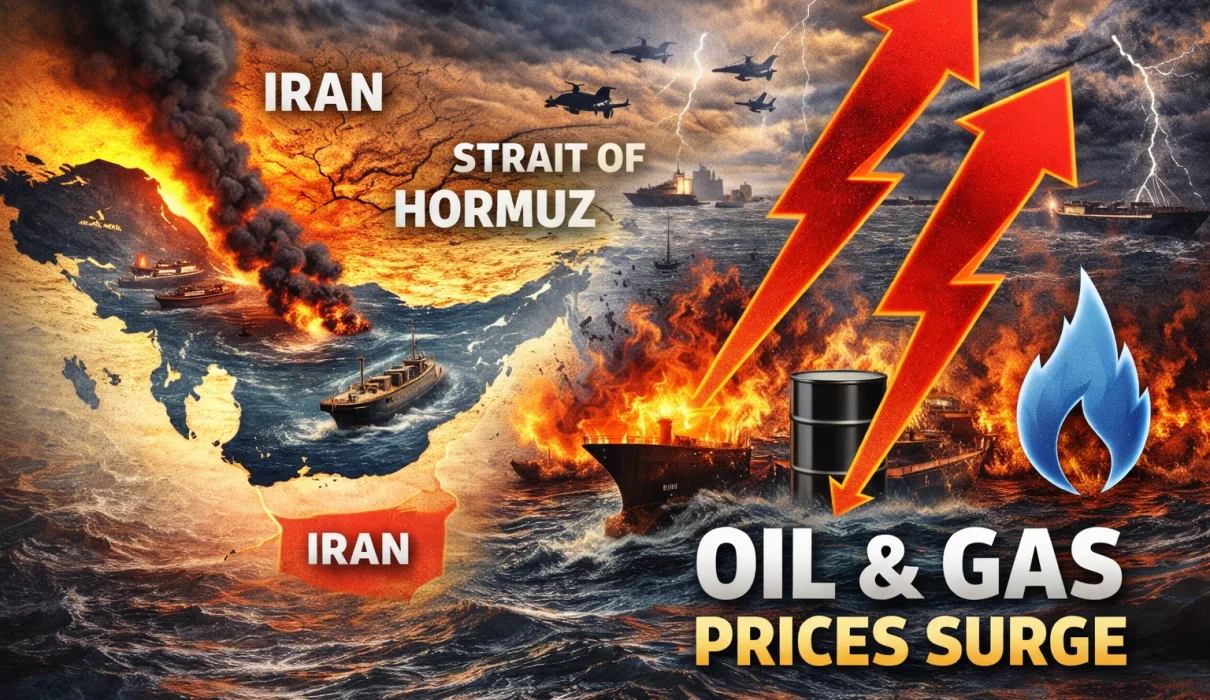
By The Strait of Hormuz oil prices are making headlines worldwide — and for good reason. Following U.S. and Israeli airstrikes on Iran this weekend, global energy markets are in turmoil. Tanker traffic through the strait has ground to a near halt, and oil prices have already jumped more than 8% in a single day.
At TrendingUpdatesToday.com, we break down what’s happening, what analysts say could come next, and what you should expect to pay at the gas pump.
Why the Strait of Hormuz Oil Prices Matter So Much
The Strait of Hormuz is the world’s most critical oil chokepoint. About one-third of all seaborne crude oil exports pass through it daily — that’s over 14 million barrels every single day. It also carries roughly 20% of the world’s liquefied natural gas (LNG), mostly from Qatar.
When Strait of Hormuz oil prices spike, the entire global economy feels it — from Asian factories to American gas stations.
Key facts:
- Over 150 ships are currently stranded near the strait
- Major shipping firms like Maersk have suspended crossings
- Iran’s Revolutionary Guard has claimed the strait is now “closed”
- Qatar has halted LNG production after drone strikes on its facilities
How Much Have Oil Prices Already Risen?
Markets reacted fast. Here’s a quick snapshot of Monday’s price moves:
| Benchmark | Price | Daily Change |
| Brent Crude | $79.45/barrel | +9% |
| WTI (U.S. Crude) | $72.74/barrel | +8.4% |
| European Natural Gas (TTF) | €48.66/MWh | +50% |
| U.S. Gasoline Futures | $2.496/gallon | +9.1% |
These are the highest levels since the U.S. and Israel struck Iran’s nuclear facilities in June 2025. The Strait of Hormuz oil prices impact is already being felt — and experts warn the worst may be ahead.
How High Can Strait of Hormuz Oil Prices Go?
Analysts at major banks have laid out clear price scenarios depending on how long the conflict lasts.
Short Disruption (Days to 1 Week)
Brent crude stays in the $80–$90 range. Some risk premium is already priced in. Traffic resumes quickly with minimal long-term damage.
Medium Disruption (2–4 Weeks)
JPMorgan warns that a three-to-four-week squeeze could force Gulf producers to shut down output entirely, pushing Brent above $100 per barrel. Bank of America analysts put the surge at $40–$80 per barrel above current levels.
Worst Case: Full Strait Closure
If Iran deploys mines and anti-ship missiles to enforce a full closure, Deutsche Bank analysts say Brent could race toward $200 per barrel. That scenario would almost certainly tip the global economy into a recession.
As one energy expert told CNBC: a prolonged closure of the Strait of Hormuz is “a guaranteed global recession.”
What Does This Mean for Gas Prices at the Pump?
The Iran war oil market disruption is heading straight to your local gas station — and fast.
- Average U.S. gas prices hit just under $3 per gallon Monday morning, per AAA
- Analysts at GasBuddy expect 10–30 cents per gallon increases within the next week
- Independent oil analyst Tom Kloza projects prices rising 5–10 cents per day in the short term
- Every $10 increase in crude typically adds about 25 cents to a gallon of gas, per Rice University’s Baker Institute
The full impact of the oil supply disruption Middle East may take up to six weeks to fully hit pumps, since it takes that long to process crude into retail gasoline. But early price jumps will happen much sooner.
Could the U.S. Strategic Petroleum Reserve Help?
Yes — but only partially. The U.S. Strategic Petroleum Reserve currently holds around 415 million barrels, according to the U.S. Department of Energy. The Trump administration could tap it to ease a short-term global energy crisis 2026 supply shock.
However, experts warn that in supply crises, both scale and duration matter. A reserve release slows price spikes but does not solve a prolonged Strait of Hormuz closure.
How Will the Iran War Oil Market Affect the Rest of the World?
Three-quarters of Strait of Hormuz oil exports head to China, India, Japan, and South Korea. If these countries are forced to find oil elsewhere, global demand — and prices — surge even higher.
European natural gas has already jumped 50% in a single day. The Strait of Hormuz oil prices shock echoes the 1973 Arab oil embargo — but analysts say the current disruption could be three times larger in scale.
5 FAQs: Strait of Hormuz Oil Prices and the Iran War
Q1: How will the Iran war affect gas prices for Americans? Gas prices are expected to rise 10–30 cents per gallon within days, with further increases likely if the conflict continues.
Q2: Will the Strait of Hormuz actually close completely? It has not fully closed yet, but tanker traffic has effectively halted. Even a partial, sustained disruption is enough to send Strait of Hormuz oil prices sharply higher.
Q3: How high can oil prices go because of Iran? Analysts project $90–$100 per barrel for a medium-length disruption. A worst-case full closure could push Brent crude toward $200.
Q4: Will the Strait of Hormuz closure cause a recession? A prolonged closure lasting several weeks or more would likely cause a global recession, according to multiple Wall Street analysts.
Q5: What can the U.S. government do to lower oil prices? The government can release oil from the Strategic Petroleum Reserve and pursue diplomatic solutions to shorten the conflict and reopen the strait.
Conclusion: Watch the Strait of Hormuz Oil Prices Closely
The Strait of Hormuz oil prices are at the center of the most serious global energy shock in decades. Whether this becomes a short-term price spike or a prolonged economic crisis depends entirely on how long the U.S.-Iran conflict lasts and whether tanker traffic resumes.
For now, expect higher gas prices, volatile energy markets, and continued global uncertainty. Stay ahead of every development at TrendingUpdatesToday.com — your source for fast, reliable, and clear energy and economic news.
Sources
- CNBC: How high can oil and gas prices go because of the Iran war? — cnbc.com
- CNBC: How a U.S.-Iran war could ‘immediately’ impact gas prices at the pump — cnbc.com
- CNN Business: What you should expect to pay for gas as the war with Iran continues — edition.cnn.com
- NBC News: Higher gas prices are likely coming to the pump after oil prices jump — nbcnews.com
- The Washington Post: Iran strikes stall traffic in Strait of Hormuz, rattling world markets — washingtonpost.com
- Fortune: U.S.-Israeli attack on Iran could drive up crude costs to $100 — fortune.com
- U.S. Department of Energy — Strategic Petroleum Reserve data: energy.gov
- U.S. Energy Information Administration — energy.gov
- International Energy Agency — iea.org