

 By
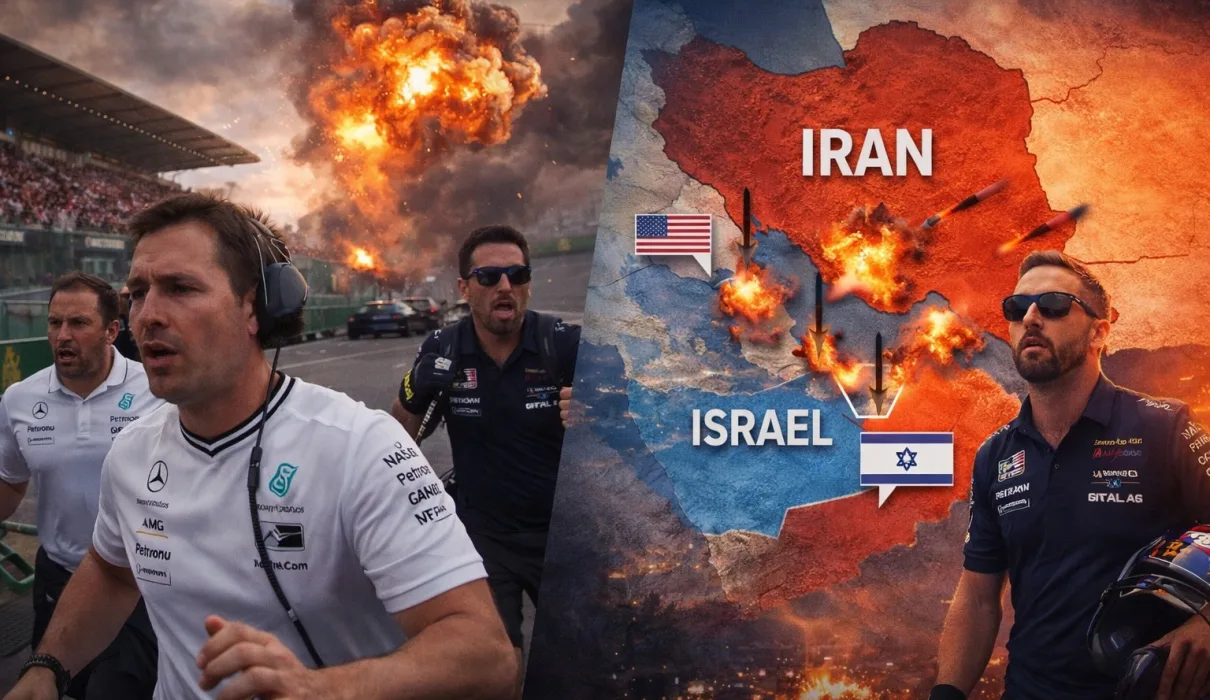
By F1 Bahrain test cancelled Iran strikes: The Middle East conflict between the US, Israel, and Iran has spilled into the world of sport. TrendingUpdatesToday.com has the full breakdown of how the escalating crisis forced Formula 1 to cancel its Pirelli Bahrain tyre test — and what could happen next for the 2026 F1 season.
What Happened: US-Israel Strikes on Iran Trigger Regional Chaos
On February 28, 2026, the United States and Israel launched a large-scale joint military operation against Iran, dubbed “Operation Epic Fury.” President Donald Trump announced the strikes, stating the goal was to eliminate Iran’s nuclear program and “defending the American people by eliminating imminent threats.”
Iran responded swiftly. It launched retaliatory missile and drone attacks across the Middle East, targeting US military bases in Bahrain, Kuwait, Qatar, Saudi Arabia, the UAE, Jordan, and Iraq.
The strikes followed the failure of the latest round of US-Iran nuclear talks in Geneva, which ended without a breakthrough just two days before the attacks began.
F1’s Pirelli Bahrain Tyre Test Cancelled for Safety Reasons
Pirelli had a two-day wet-weather tyre test scheduled at the Bahrain International Circuit in Sakhir. The test used artificial track sprinklers and mule cars supplied by Mercedes and McLaren to gather crucial data on rain compounds ahead of the 2026 season.
It never happened.
Iran’s retaliatory strikes hit the service centre of the US Navy’s Fifth Fleet in Bahrain — reportedly just 15 miles from the F1 circuit. Videos circulated on social media showing explosions approximately 20km from the track.
Pirelli acted quickly. In a statement provided to RacingNews365, the company confirmed:
“The two days of development tests for wet-weather compounds, scheduled for today and tomorrow at the Bahrain International Circuit, have been cancelled for security reasons following the evolving international situation. All Pirelli personnel currently in Manama are safe in their hotels. The company is working to ensure their safety and arrange their return to Italy and the UK as soon as possible.”
All F1 and Pirelli personnel on site were confirmed safe.
How the Iran Strikes Are Disrupting F1 Travel
The broader Middle East conflict is creating serious logistical problems for the sport. With the Australian Grand Prix set for March 8 in Melbourne, around 2,000 F1 and team personnel need to travel from Europe — and many routes pass through Dubai or Doha.
Both Dubai International Airport and Doha’s Hamad International Airport closed due to the conflict. F1 staff are now rerouting via Hong Kong and Singapore to reach Australia.
F1 issued the following statement:
“Our next three races are in Australia, China and Japan, not in the Middle East — those races are not for a number of weeks. As always, we closely monitor any situation like this and work closely with relevant authorities.”
What About the Bahrain Grand Prix and Saudi Arabian GP?
Here is where the real concern lies for the 2026 F1 season.
| Race | Date | Status |
| Australian Grand Prix | March 8, 2026 | Confirmed — no disruption |
| Chinese Grand Prix | March 22, 2026 | Confirmed — no disruption |
| Japanese Grand Prix | April 6, 2026 | Confirmed — no disruption |
| Bahrain Grand Prix | April 12, 2026 | Monitoring — no cancellation yet |
| Saudi Arabian GP | April 19, 2026 | Monitoring — no cancellation yet |
The Bahrain Grand Prix remains on the calendar for April 12, with Saudi Arabia following one week later. The FIA and Formula 1 are closely monitoring the situation, and F1 is understood to have contingency plans in place if security deteriorates.
This is not the first time F1 has faced a scare in the region. In 2022, a missile struck an Aramco oil depot just kilometers from the Jeddah Corniche Circuit during a practice session, yet the race still went ahead after marathon overnight discussions between drivers, the FIA, and local officials.
Could Other Sports Events Be Affected?
The Iran missile attacks closed airspace across multiple countries, including the UAE, Saudi Arabia, Qatar, Bahrain, and Kuwait. This affects all international events scheduled in the region. Any sport relying on Middle Eastern transit hubs for athletes and officials faces potential disruption.
The Strait of Hormuz — through which roughly one-third of the world’s seaborne oil exports passed in 2025, according to PBS NewsHour — also faces risk, which could drive up fuel costs and global logistics expenses affecting sports travel budgets worldwide.
F1’s History of Racing Through Conflict
Formula 1 has a long record of pressing on in difficult geopolitical climates. The sport has raced in the Middle East through regional tensions, diplomatic crises, and security scares. F1’s commercial and broadcasting commitments make cancellations extremely costly.
Still, the 2026 Iran strikes represent a qualitatively different situation — an active, large-scale war with missiles hitting multiple host countries simultaneously. The FIA will need to weigh athlete safety against contractual obligations as the April races approach.
F1 Bahrain test cancelled Iran strikes: Conclusion
The US-Israel strikes on Iran and the subsequent Iranian missile retaliation have already cancelled one F1 event and created serious travel disruption across the sport. As TrendingUpdatesToday.com will continue to follow, all eyes are now on whether the Bahrain Grand Prix and Saudi Arabian Grand Prix can safely go ahead in April 2026. With the military situation fluid and airspace closures ongoing, Formula 1 faces one of its most complex logistical and ethical challenges in recent memory.
FAQs
1. Why was the Pirelli F1 tyre test in Bahrain cancelled? Pirelli cancelled the two-day wet-weather tyre test at the Bahrain International Circuit on February 28, 2026, after Iranian missile strikes hit the US Navy’s Fifth Fleet base in Bahrain — just 15 miles from the circuit. All personnel were confirmed safe.
2. Will the 2026 Bahrain Grand Prix be cancelled because of the Iran conflict? As of March 1, 2026, the Bahrain Grand Prix scheduled for April 12 has not been cancelled or postponed. Formula 1 and the FIA are monitoring the evolving security situation and have contingency plans in place.
3. How are the US-Israel strikes on Iran affecting F1 travel to Australia? Major transit airports in Dubai and Doha closed following the conflict, forcing around 2,000 F1 personnel to reroute via Hong Kong and Singapore to reach Melbourne for the Australian Grand Prix on March 8.
4. What was the US-Israel operation against Iran called? The US Department of Defense named the joint military campaign “Operation Epic Fury.” President Trump announced it was aimed at eliminating Iran’s nuclear and missile programs and encouraging regime change.
5. Which Middle Eastern F1 race venues were affected by Iranian missile strikes? Iran launched retaliatory strikes on countries hosting US military bases, including Bahrain, Kuwait, Qatar, Saudi Arabia, and the UAE — all of which either host or have hosted Formula 1 Grand Prix events.

Sources
- RacingNews365 — “F1 testing cancelled due to Middle East safety concerns” (racingnews365.com)
- GPFans — “F1 issues statement about Bahrain and Saudi Arabian GPs after Iran missile attacks” (gpfans.com)
- PBS NewsHour — “U.S. and Israel launch a major attack on Iran” (pbs.org)
- CNN — “Why the US and Israel attacked Iran; what we know so far” (cnn.com)
- Council on Foreign Relations — “Gauging the Impact of Massive U.S.-Israeli Strikes on Iran” (cfr.org)
- Al Jazeera — “US, Israel bomb Iran: A timeline of talks and threats” (aljazeera.com)
- Sports Illustrated / On3 — “F1 Issues Statement Over Middle East Tensions as Pirelli Testing Cancelled” (si.com)
- Britannica — “US-Israel-Iran Conflict (2025–26)” (britannica.com)