

 By
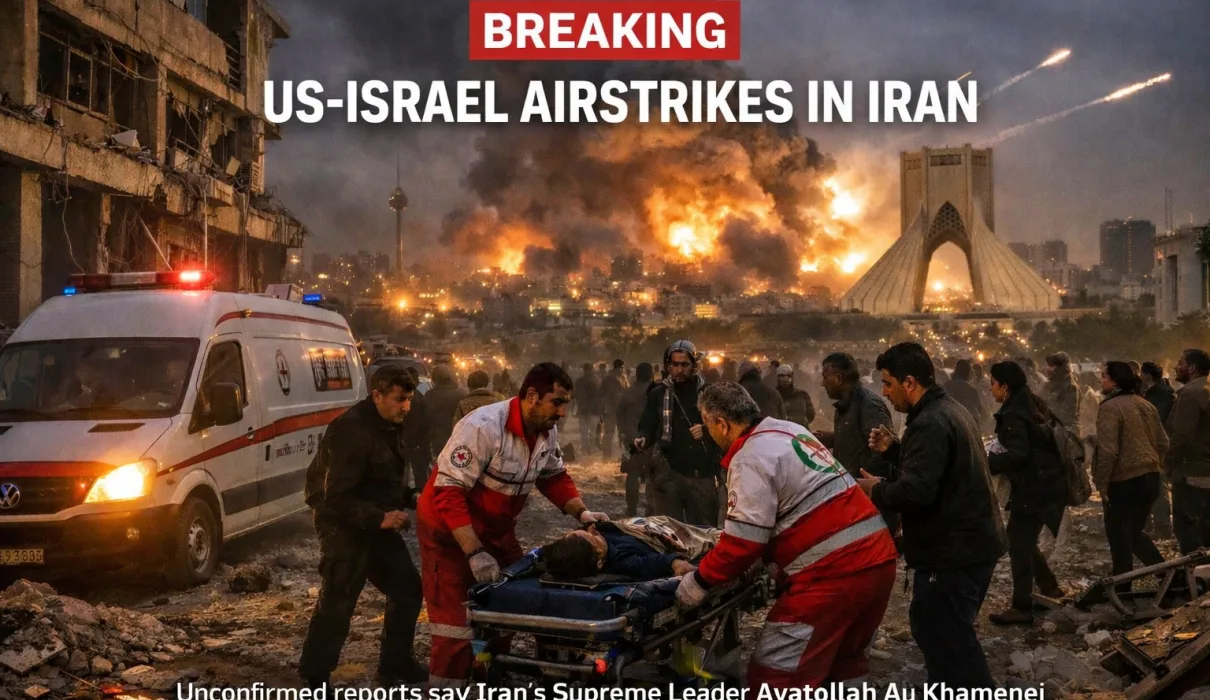
By On Saturday, February 28, 2026, Iran’s supreme leader, Ayatollah Ali Khamenei, was reportedly killed during coordinated US-Israel airstrikes on Tehran. TrendingUpdatesToday.com breaks down the key facts, the background, and what this historic event could mean for Iran and the wider world.

What Happened: The Airstrike That Shook the Middle East
The United States and Israel launched a large-scale joint military operation against Iran on Saturday morning. Airstrikes targeted several high-value sites across the country, including the supreme leader’s compound in Tehran.
Satellite imagery from Airbus showed thick black smoke rising from Khamenei’s compound. Multiple buildings in the complex appeared severely damaged.
US President Donald Trump announced Khamenei’s death on Truth Social, calling it “the single greatest chance for the Iranian people to take back their Country.” Two Israeli intelligence sources independently confirmed Khamenei’s death to CNN.
Iran’s Foreign Ministry initially pushed back. A spokesman stated that Khamenei and Iran’s president were both “safe and sound.” However, Khamenei had not appeared publicly or in any video since the strikes began.

What Led to the US-Israel Attack on Iran?
The joint US-Israel operation did not happen in a vacuum. Several events over the past year severely weakened Iran’s position:
- June 2025 — A previous round of US and Israeli strikes dealt a major blow to Iran’s military and nuclear infrastructure.
- Late 2025 — Massive protests erupted across all 31 Iranian provinces, driven initially by economic hardship before turning into direct political opposition to the regime.
- Early 2026 — The Iranian government cracked down violently on protesters, killing thousands and drawing sharp international condemnation.
- February 28, 2026 — Trump declared the US was conducting a “massive and ongoing operation” to prevent Iran from threatening American national security, and publicly called for regime change.
Decades of Western sanctions had already left Iran’s economy badly weakened, making the regime increasingly fragile before the strikes.

Who Could Replace Khamenei as Iran’s Supreme Leader?
Khamenei ruled Iran for nearly 37 years after succeeding Ayatollah Khomeini in 1989. His sudden death leaves a serious power vacuum — and no obvious successor.
Under Iran’s constitution, the Assembly of Experts holds the authority to appoint a new supreme leader. Until a permanent appointment is made, a temporary three-member council steps in. This council includes the president, the head of the judiciary, and a jurist from the Guardian Council.
However, US Secretary of State Marco Rubio acknowledged in January 2026 that “no one knows” who would take power if Khamenei fell. Experts warn that the Islamic Revolutionary Guard Corps (IRGC) could move quickly to assert control, potentially leading to an even more hard-line government.
| Scenario | Likely Outcome |
| IRGC seizes power | More extreme, military-backed regime |
| Assembly of Experts appoints successor | Continuation of theocratic rule |
| Widespread public uprising | Possible transition toward secular governance |
| International intervention shapes outcome | Deeply uncertain; risk of prolonged conflict |

How Are Iranians Reacting?
Inside Iran, the reaction was deeply divided.
Videos shared on social media showed some Tehran residents cheering and celebrating when news of Khamenei’s death spread. Women were heard chanting “Death to the Islamic Republic” and “Long Live the Shah.” Protests over the past year had already featured crowds calling directly for Khamenei’s removal.
At the same time, other Iranians demonstrated against the US-Israel strikes, viewing foreign military action as an attack on Iranian sovereignty. This tension reflects the complex feelings many Iranians hold — opposing the regime while also resisting foreign interference.

What This Means for the Middle East and Global Economy
The potential death of Iran’s supreme leader could trigger the biggest shift in regional dynamics since the Hamas-led attack on Israel on October 7, 2023.
Iran funds and supports a network of regional proxy groups, including Hezbollah in Lebanon and militant factions in Iraq and Yemen. A sudden power vacuum in Tehran could destabilize all of these relationships simultaneously.
Analysts also warn of serious risks to the global economy. Iran sits at the heart of a region critical to global energy supplies. Political chaos following Khamenei’s death could send oil prices sharply higher and rattle financial markets.
It would also mark the second time the United States has acted to remove an Iranian leader from power — the first being the CIA-backed 1953 coup that overthrew Prime Minister Mohammad Mossadegh, an event that still deeply shapes Iranian political identity.
Conclusion
The reported killing of Ayatollah Khamenei in a joint US-Israel airstrike marks one of the most consequential geopolitical events of the 21st century. Iran now faces its deepest crisis since the 1979 Islamic Revolution, with no clear successor, a broken economy, and a restless population. Whether this leads to genuine democratic change or a harder military dictatorship remains to be seen. Stay with TrendingUpdatesToday.com for the latest verified updates as this story continues to develop.
❓ Frequently Asked Questions (FAQs)
1. Is Ayatollah Khamenei confirmed dead? US President Donald Trump and two Israeli intelligence sources confirmed Khamenei’s death on February 28, 2026. Iran’s Foreign Ministry initially denied it, but Khamenei made no public appearance after the strikes.
2. Who ordered the airstrikes that killed Khamenei? President Trump announced a joint US-Israel military operation targeting Iran’s leadership, with regime change stated as one of its goals.
3. Who will replace Khamenei as Iran’s supreme leader? Under Iran’s constitution, the Assembly of Experts appoints a new supreme leader. A temporary three-member council governs in the interim. No clear successor has been publicly identified.
4. How are Iranians reacting to Khamenei’s death? Reactions are split. Some Iranians celebrated in the streets, while others protested the foreign military strikes on Iranian soil.
5. What impact will Khamenei’s death have on the Middle East? Experts say it could trigger major regional instability, disrupt Iran’s proxy network across the Middle East, and create significant risks for global oil markets and geopolitical security.
Sources
- CNN International — “Iranian leader Khamenei is dead, Trump and Israeli sources say” (February 28, 2026): edition.cnn.com
- Middle East Institute — “Moving to a Post-Khamenei Era: The Role of the Assembly of Experts”: mei.edu
- Airbus Defence & Space — Satellite imagery of Tehran, February 28, 2026
- The White House — Official statement and imagery of President Trump monitoring Iran operations, February 28, 2026