

 By
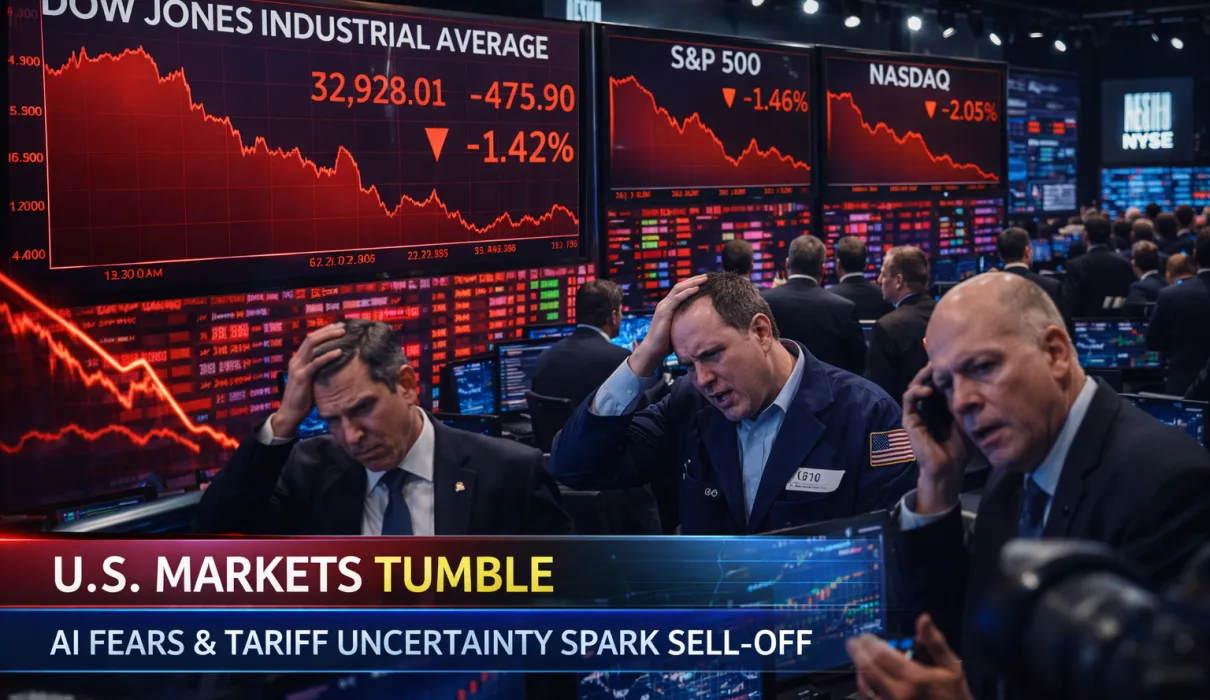
By The Wall Street stock market crash on February 23, 2026, hit investors hard. All three major U.S. stock indexes closed more than 1% lower, as two powerful forces collided: growing AI displacement fears and renewed Trump tariff policy chaos. TrendingUpdatesToday.com breaks down exactly what happened, who got hit hardest, and what it means for your portfolio.
What Triggered the Stock Market Selloff?
The stock market selloff started with a one-two punch over the weekend.
First, the U.S. Supreme Court struck down President Trump’s sweeping “reciprocal” tariff policy on Friday, ruling 6-3 that the president overstepped his authority under the International Emergency Economic Powers Act (IEEPA). Instead of easing trade tensions, the ruling triggered a fresh wave of uncertainty. Trump responded on Saturday by announcing new 15% blanket tariffs on countries he accused of “playing games,” escalating the standoff with trading partners including the European Union.
Second, investors continue to grow anxious about how far AI disruption will spread across industries. Companies in cybersecurity, software, and financial services took the biggest beatings as Wall Street processed the growing risk that AI-powered competitors could steal revenue and reset entire business models.
How AI Displacement Fears Are Rattling Markets
AI displacement fears are no longer abstract. They are moving stock prices in real time.
CrowdStrike fell 9.8% on Monday, bringing its year-to-date loss to over 25%. AppLovin sank 9.1%, now down more than 43% in 2026. Software stocks as a group dropped 4.3%, while financial stocks fell 3.3%.
The concern is straightforward. As AI models become more capable and affordable, they undercut the value of existing software tools. Investors are asking two questions, as Tom Hainlin of U.S. Bank Wealth Management put it: “How much is it going to cost, and who all is going to be disrupted?”
That uncertainty is enough to trigger broad selling, even in companies that have not yet reported any concrete revenue impact from AI competition.
| Sector | Monday’s Decline | YTD Performance |
| Software stocks | −4.3% | Deeply negative |
| Financial stocks | −3.3% | Negative |
| S&P 500 | −1%+ | Mixed |
| Nasdaq | −1.1% | Under pressure |
| Dow Jones | −1.7% (821 pts) | Negative |
How Trump Tariff Policy Is Driving Market Volatility 2026
Trump tariff policy has been one of the biggest drivers of market volatility 2026. Even after the Supreme Court struck down his sweeping levies, Trump wasted no time in announcing replacement tariffs, moving from 10% to 15% on many trading partners.
The European Commission immediately pushed back, stating the situation was “not conducive” to the fair and balanced trade deal both sides had agreed to in August 2025. This back-and-forth between Washington and global trade partners continues to erode investor confidence.
How Trump tariffs affect the stock market is no longer a theoretical question. Analysts say each new tariff announcement adds a fresh layer of uncertainty that forces investors to reprice risk across the board, contributing directly to the current S&P 500 decline.
The Magnificent Seven: No Longer a Safe Bet
The so-called Magnificent Seven tech giants that drove markets to record highs are struggling in 2026. Five of the seven are in negative territory for the year. Microsoft is down nearly 18%. Tesla and Amazon have each shed more than 8%. Alphabet is roughly flat, and Nvidia has gained just 1%.
The Roundhill Magnificent Seven ETF (MAGS) is down nearly 6% year to date. Wall Street falls on AI disruption and tariffs have hit these stocks from two directions at once: rising capital expenditure costs for AI infrastructure and the threat that cheaper, faster AI models will disrupt the very markets they dominate.
What Investors Are Watching Next
All eyes now turn to Nvidia’s earnings report, due Wednesday. As the world’s leading AI chipmaker, Nvidia’s results will signal whether spending on AI infrastructure remains strong or whether companies are starting to pull back.
Home Depot, Lowe’s, and Salesforce also report this week. Any weakness in Salesforce’s numbers could deepen software stocks drop fears and add further pressure to the financial stocks fall trend.
The Fed is also in focus. Fed Governor Christopher Waller said he needs to see the February jobs report before making any judgment on the next rate decision. AI stocks losing value in 2026 adds complexity to an already uncertain monetary policy picture.
Wall Street Stock Market Crash: Conclusion
The Wall Street stock market crash on February 23 reflects a market under siege from multiple directions. AI displacement fears are reshuffling winners and losers across entire industries. Trump tariff policy keeps injecting fresh uncertainty into global trade. And the Supreme Court tariff ruling stock market impact has not stabilized things — it has made them more unpredictable.
For investors trying to navigate this turbulence, staying informed is critical. TrendingUpdatesToday.com will continue to track the latest developments in market volatility 2026 as Nvidia earnings, new tariff moves, and Fed policy signals shape what comes next.
Frequently Asked Questions
1. Why did the Wall Street stock market crash on February 23, 2026? The Wall Street stock market crash was caused by two factors: renewed AI displacement fears hitting software and financial stocks, and Trump’s announcement of new 15% tariffs following a Supreme Court ruling that struck down his earlier trade levies.
2. Which sectors saw the biggest stock market selloff? Software stocks dropped 4.3% and financial stocks fell 3.3%, leading the stock market selloff. Airlines and travel stocks also declined sharply due to a major winter storm in the Northeast.
3. How does Trump tariff policy affect everyday investors? Trump tariff policy increases costs for imported goods, raises inflation risk, and adds market volatility 2026 that can reduce the value of stock portfolios, retirement accounts, and ETFs exposed to affected sectors.
4. Why did the S&P 500 decline alongside the Nasdaq and Dow? The S&P 500 decline reflected broad investor risk aversion. When both trade policy and AI disruption fears hit simultaneously, investors tend to reduce exposure across all asset classes, pulling all three major indexes lower.
5. What should investors watch to understand Wall Street falls on AI disruption and tariffs? Watch Nvidia’s upcoming earnings report closely, along with any new tariff announcements from the White House and Federal Reserve statements on interest rate policy. These will be key signals for where the market heads next.
Sources
- Reuters via MarketScreener — Wall Street ends sharply lower amid AI displacement fears and revived tariff angst (Feb. 23, 2026)
- CNBC — Dow drops 800 points as AI disruption fears and tariff woes weigh on markets (Feb. 23, 2026): https://www.cnbc.com/2026/02/22/stock-market-today-live-updates.html
- Associated Press via WDRB — U.S. stocks drop after Trump ramps up tariffs and investors dump potential AI losers (Feb. 23, 2026)
- U.S. Supreme Court — IEEPA ruling on presidential tariff authority (Feb. 2026)
- Federal Reserve — Governor Christopher Waller speech on labor market and rate policy (Feb. 2026)
- European Commission — Statement on U.S.-EU trade commitments following Supreme Court ruling (Feb. 2026)