

 By
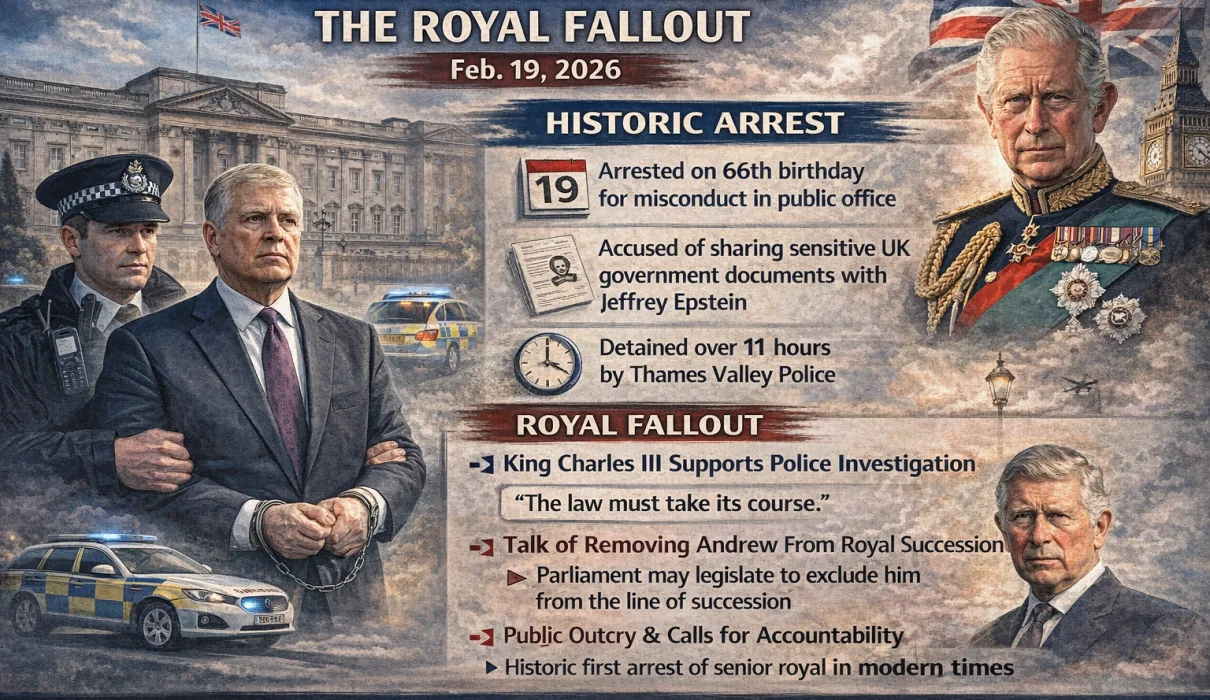
By Prince Andrew Arrest Epstein: The British monarchy is facing what experts are calling its most serious constitutional crisis in decades. On February 19, 2026 — his 66th birthday — Andrew Mountbatten-Windsor, formerly known as Prince Andrew, was arrested on suspicion of misconduct in public office, becoming the first senior British royal to be taken into police custody in modern history. TrendingUpdatesToday.com has been tracking the rapidly unfolding developments, and what’s emerged is a story that touches on royal accountability, the Jeffrey Epstein scandal, and the future of the British Crown.
King Charles Issues Unprecedented Statement on Prince Andrew Arrest
King Charles’s statement on Prince Andrew’s arrest was swift and unambiguous. Signing the statement personally — an unusual move for the monarch — King Charles said he had learned of the news “with the deepest concern” and called for a “full, fair and proper” investigation. “Let me state clearly: the law must take its course,” he declared, pledging “full and wholehearted support and co-operation” to the authorities.
Experts noted the tone was deliberate. Craig Prescott, a constitutional law specialist at Royal Holloway, University of London, described the moment as “extraordinary” and “unprecedented in modern times.” Prince William and Princess Catherine also backed the King’s statement, presenting a united royal front distancing the family from Andrew Mountbatten-Windsor.
What Led to Andrew Mountbatten-Windsor Being Arrested?
The Prince Andrew arrest Epstein connection traces back years. Andrew served as the UK’s Special Representative for Trade and Investment from 2001 to 2011, during which time he maintained a well-documented friendship with convicted sex offender Jeffrey Epstein. Police began reviewing allegations that Andrew shared sensitive government information with Epstein while serving in that official capacity.
Thames Valley Police confirmed they arrested “a man in his sixties from Norfolk on suspicion of misconduct in public office,” carrying out simultaneous searches at properties in Berkshire and Norfolk — including Wood Farm on the Sandringham estate and the former Royal Lodge on the Windsor estate. In England and Wales, misconduct in public office is a serious common law offense that carries a maximum sentence of life imprisonment if convicted, according to the Crown Prosecution Service.
Andrew Mountbatten-Windsor was released under investigation later the same day, meaning he faces no formal charges at this time but remains the subject of an active police inquiry.
Royal Timeline: Andrew’s Fall From Grace
| Year | Event |
| 2001 | Appointed UK Trade Envoy |
| 2011 | Resigned after Epstein photo scandal |
| 2019 | Disastrous BBC Newsnight interview with Emily Maitlis |
| 2022 | Removed as a working senior royal |
| 2025 | Stripped of “Prince” title; evicted from Royal Lodge |
| Feb. 2026 | Arrested at Sandringham on his 66th birthday |
Can King Charles Pardon Prince Andrew?
One question dominating public debate: Can King Charles pardon Prince Andrew after the arrest? Technically, yes — the monarch holds what is known as the “royal prerogative of mercy,” which allows the ruling British monarch to pardon persons convicted of criminal offenses, according to the UK Government.
However, legal experts say a pardon is extremely unlikely. Robert Hazell, Director of the Constitution Unit at University College London, told USA TODAY that King Charles “has no discretion independently to exercise the prerogative of mercy” and can only do so on the advice of the government. Beyond the legal constraints, public sentiment makes such a move politically toxic. A 2025 Ipsos poll found that 88% of Britons supported stripping Andrew of his royal titles — suggesting little appetite for royal leniency.
A Royal Family Crisis Bigger Than Diana?
NBC News royal commentator Daisy McAndrew argued the Andrew Mountbatten-Windsor arrest represents a crisis “a lot more serious” for the royal family than the fallout following Princess Diana’s death. Unlike the public perception failures of 1997, this is a direct criminal investigation implicating a member of the royal family in matters tied to one of the most notorious criminal enterprises of modern times.
Support for the British monarchy has also been declining. Research by the National Centre for Social Research shows that the share of Britons who consider the monarchy “very important” or “quite important” dropped from 86% in 1983 to just 51% in 2025. The arrest of the King’s brother threatens to accelerate that trend.
Royal historian Ed Owens described the arrest as a “bomb” that “has gone off at the start of King Charles’ reign.”
Strong Conclusion
The Prince Andrew arrest Epstein case marks an inflection point for the British royal family. King Charles’s decisive response — refusing to shield his brother from accountability — may prove critical in preserving the monarchy’s legitimacy. But with Andrew Mountbatten-Windsor still under investigation, no charges filed, and public trust in the institution already fraying, the road ahead is uncertain. For all the latest updates on this developing royal family Epstein scandal and other major stories, bookmark TrendingUpdatesToday.com.
FAQs
1. Why was Prince Andrew arrested in 2026? Andrew Mountbatten-Windsor was arrested on suspicion of misconduct in public office on February 19, 2026, over allegations that he shared sensitive government information with convicted sex offender Jeffrey Epstein while serving as a UK trade envoy.
2. What did King Charles say about Prince Andrew’s arrest? King Charles issued a personal statement saying he learned of the Prince Andrew arrest with “the deepest concern” and that “the law must take its course,” pledging the authorities his “full and wholehearted support and co-operation.”
3. Can King Charles pardon Prince Andrew if he is convicted? Technically, King Charles holds the royal prerogative of mercy, but constitutional experts say he can only exercise it on the advice of the government — and public opinion strongly opposes any such pardon.
4. Was Prince Andrew charged with a crime? No. Andrew Mountbatten-Windsor was released under investigation on February 19, 2026, meaning the inquiry is ongoing but no formal charges have been filed as of this writing.
5. How serious is misconduct in public office in the UK? Under British law, misconduct in public office is a common law offense that can result in a maximum sentence of life imprisonment if a person is convicted, according to the Crown Prosecution Service.
Sources
- NBC News: Andrew King Charles Epstein Royal Crisis
- CNN: King Charles Andrew Arrest Royal Crisis
- Newsweek: King Charles Prince Andrew Arrest
- Yahoo News / USA TODAY: Can King Charles Pardon Prince Andrew
- Crown Prosecution Service (UK Gov): Misconduct in Public Office
- National Centre for Social Research: Monarchy polling data, 2025