

 By
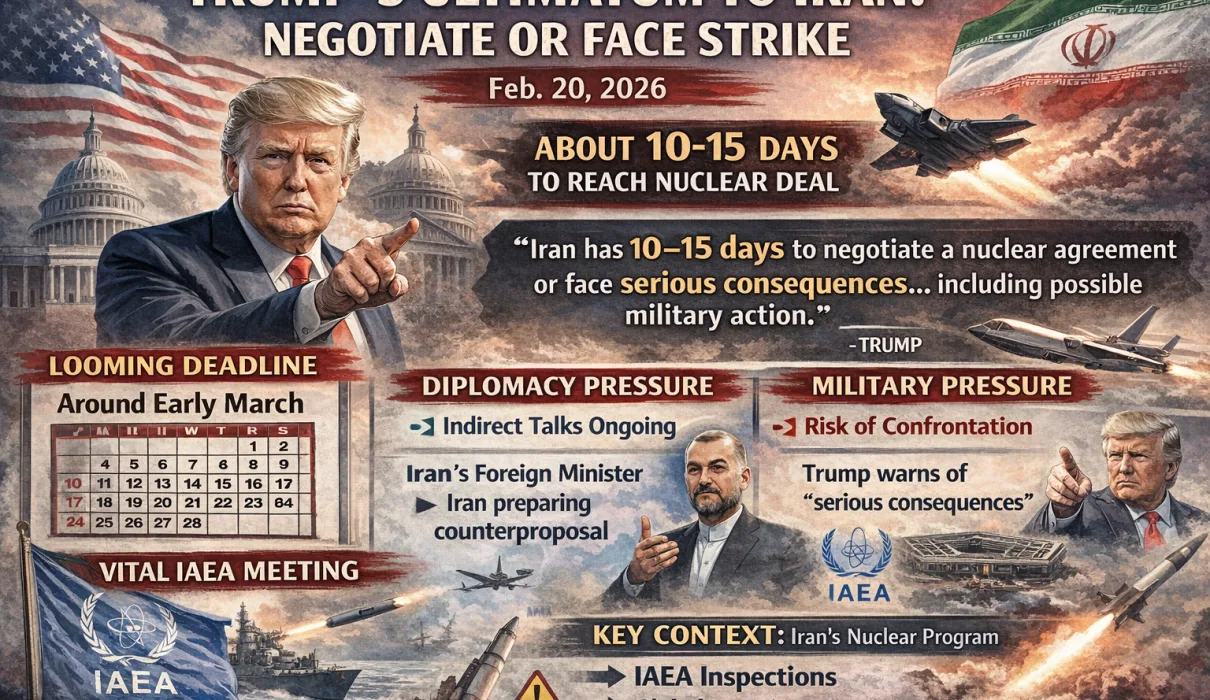
By The world is watching a diplomatic countdown unfold in real time. As reported by TrendingUpdatesToday.com and confirmed by multiple global news agencies, President Donald Trump has issued a stark Trump Iran nuclear deal deadline — warning Tehran it has just 10 to 15 days to reach a meaningful agreement or face what he called “unfortunate” consequences. With the International Atomic Energy Agency (IAEA) board scheduled to convene in Vienna on March 2, 2026, the window for diplomacy is razor-thin.
Trump’s Iran Ultimatum: What He Said and Why It Matters
Speaking at the inaugural Board of Peace meeting in Washington on February 19, Trump left little room for ambiguity. “They must make a deal. If that doesn’t happen… bad things will happen,” Trump said. The Times of Israel Asked later aboard Air Force One about his timeline, he was equally blunt: “I would think that would be enough time — 10, 15 days, pretty much maximum.”
This Trump Iran ultimatum is significant not just for its language, but for its timing. The 10-to-15-day window lands almost precisely on the IAEA’s scheduled five-day board meeting in Vienna — a session at which diplomats are expected to weigh a new resolution censuring Iran over its nuclear program and potentially refer the matter to the UN Security Council.
The IAEA Meeting: A Flashpoint in the Making
The IAEA board meeting starting March 2 sets up a potential repeat of events that played out in June, when Israel began strikes within 24 hours of the IAEA board’s decision to censure Iran over its lack of cooperation with monitors. Business Standard That precedent is not lost on analysts or policymakers.
Tariq Rauf, the former head of nuclear-verification policy at the IAEA, warned that the situation “potentially gives the administration the hook it needs to attack Iran in an attempt to affect regime change.” Business Standard
Meanwhile, IAEA Director General Rafael Grossi has tried to hold the door open for diplomacy. “The problem is, we don’t have much time,” Grossi said, noting that most of Iran’s enriched uranium stockpile remains largely intact despite previous strikes. CBS News The agency has not been able to verify the status of Iran’s near-bomb-grade uranium for more than eight months.
Where Iran US Nuclear Talks Stand Right Now
The most recent round of Iran US nuclear talks took place in Geneva on February 18, 2026. IAEA Director General Grossi noted an “obvious” gap between US and Iranian positions, with Washington demanding a complete halt to all uranium enrichment while Iran insists on retaining some fuel-making capacity for peaceful purposes. Iran International
Iran’s Foreign Minister Abbas Araghchi struck a slightly more optimistic tone, stating both sides were discussing a “fast deal” and that a draft agreement could be presented to Washington within days. The US and Iran have now held two rounds of indirect, Omani-mediated talks.
US–Iran Military Posture: Forces on the Move
Alongside diplomacy, the US has significantly expanded its military footprint in the Middle East. Washington has reinforced its regional military posture, including carrier strike groups and additional naval assets, amid concerns that diplomacy could stall. Iran International
Russia and Iran also conducted joint naval exercises in the Strait of Hormuz this week — a visible signal of aligned interests as tensions mount. Grossi stressed to French network TF1 that another US–Iran military confrontation carried a “real risk of spillover and expansion to other countries.”
Oil Markets and Global Economic Impact
The question of whether the US will strike Iran over its nuclear program is already rattling financial markets. The prospect of a war between the US and Iran has pushed Brent crude above $71 a barrel, near six-month highs, and on course for a 5% weekly gain. Business Standard The US dollar posted its strongest week since November as investors sought safe-haven assets.
Key Actors and Positions at a Glance
| Actor | Position |
| United States | Full halt to uranium enrichment; military buildup in region |
| Iran | Retains enrichment rights; preparing written deal proposal |
| IAEA (Grossi) | Urges diplomacy; warns of risk of regional escalation |
| Israel | Supports US stance; conducted prior strikes in June 2025 |
| Russia & China | Support Iran; held joint IAEA meeting to oppose use of force |
| UN Security Council | May receive Iran referral following March 2 IAEA board meeting |
What Happens If No Deal Is Reached?
If the Trump Iran nuclear deal deadline passes without agreement, the IAEA’s March 2 board meeting could serve as the legal and political catalyst for military action. Iran has accused the IAEA of providing intelligence used in prior strikes, while IAEA’s Grossi has repeatedly insisted Iran has a legal obligation to allow full inspector access to its nuclear sites. Arms Control Association
Iran, for its part, has warned the UN Secretary-General that “all bases, facilities, and assets” of the United States in the region could face retaliation should an attack be launched — a warning that raises the stakes for every country in the Middle East and beyond.
Conclusion
The world is at a pivotal crossroads. A diplomatic resolution to the Iran nuclear program threat remains possible, but the window is closing fast. Whether through deal or conflict, the next 10 to 15 days may reshape the Middle East for years to come. For ongoing coverage of this developing story, keep following TrendingUpdatesToday.com.
Frequently Asked Questions
1. What is Trump’s Iran nuclear deal deadline? President Trump warned Iran on February 19, 2026, that it has approximately 10 to 15 days to reach a meaningful nuclear deal with the United States or face potential military consequences.
2. Why does the IAEA board meeting in March 2026 matter? The IAEA board is scheduled to meet in Vienna on March 2, 2026 — precisely within Trump’s deadline window. The board may censure Iran and refer it to the UN Security Council, which could be used as legal justification for US military action, mirroring what occurred in June 2025.
3. What is the core dispute in Iran US nuclear talks? The central issue is uranium enrichment. The US demands Iran halt all enrichment activity and dismantle facilities. Iran insists on retaining some enrichment capability for what it calls peaceful, civilian purposes.
4. Will the US strike Iran over its nuclear program? No final decision has been made. However, the US has significantly expanded its military presence in the Middle East, and Trump has not ruled out a military strike if negotiations fail within his stated deadline.
5. How is Iran’s nuclear program threatening global oil markets? Growing fears of a US–Iran military conflict have driven Brent crude oil prices above $71 a barrel, near six-month highs, with markets pricing in significant supply disruption risk from the Persian Gulf region.
Sources
- Bloomberg: Trump’s Iran Ultimatum Sets Stage for Strike During IAEA Meeting
- CBS News: Iran nuclear material “still there, in large quantities,” IAEA chief says
- Times of Israel: Trump warns Iran of ‘bad things’ if no deal made
- Arms Control Association: Trump Threatens New Military Action Against Iran
- Iran International: Trump signals Iran deal deadline as reports point to limited strike plans
- Business Standard: Trump’s Iran ultimatum sets up potential attacks following IAEA meeting